A practical guide to tense conversations
When asked an uncomfortable question, there are many possible responses. One can lie, but this requires skill. One can feign ignorance, but this requires a degree of credibility. Both require a good memory.
The never answer is superior. It requires almost nothing. The approach is simple: you respond, but you never answer the question. There are many ways to accomplish this. Done properly, you can respond at considerable length, say nothing demonstrably false, maybe even provide a fair amount of information, and still leave the questioner knowing nothing more, and likely less, than when they started.
The pesky parents
Consider the following hypothetical scenario. A high school math team is preparing for the state championship. The assistant coach announces that the two students with the highest scores on the final exam will represent the school.
The exam is held. Student A scores 92, placing second. Student B scores 89, placing third.
The assistant selects Student B.
Some parents, former mathletes themselves, ask why.
The assistant explains that, despite the apparent difference in scores, the two students were “tied.”
Redefine the inconvenient fact
Parents: But they weren’t tied. A scored 3 points higher.
Assistant: In this case, I consider that a tie.
Parents: But mathematically, that’s not a tie.
Assistant: Not necessarily. You’re only thinking of arithmetic.
The students were not tied in the mundane “arithmetic” sense, which requires them to have identical scores. The tie in this case was much more nuanced. Understanding it requires not only basic math, but an advanced degree.
This response is magic. The assistant coach has not denied the exam results. He has not disputed A’s ranking. He has not explicitly claimed that 92 = 89. The response expands the definition of a tie until it is broad enough to also include not tying. Simple.
Sadly, the pesky parents also have advanced degrees. They insist on answers.
Introduce a competing explanation
The head coach enters the chat.
Coach: To clarify what happened, the championship team wasn't selected based on the final qualifying exam. My assistant actually used the students’ scores over the entire semester.
The parents, unfortunately, check. Student A's best score is also higher than Student B's. Perhaps the coach meant the average. A’s average is lower, but B still ranks third overall. The median? Still no. Hopefully, this continues indefinitely.
The parents have now been given two different explanations for the decision, neither of which explains the decision clearly. The parents remain unsatisfied.
Time for a new approach.
Correct the questioner
The parents refuse to listen to reason. They must have become emotionally attached.
Coach: If you have concerns in the future, I encourage you to express them in a more constructive manner.
The underlying question is how the stated criterion resulted in Student B being selected. Nevertheless, the topic has shifted to the parents’ communication style and future opportunities for personal growth. They may now be wondering whether they are actually the problem. This is substantial progress. In extreme cases, however, they may continue prodding.
Luckily, this too can be corrected.
Turn the tables
Assistant: This was a very difficult decision for me. Both students are terrific. A worked so hard during the semester. Telling him that B qualified was really tough. We are all people, not just numbers.
A moment ago, the parents were questioning why the assistant coach chose B when A was the one who qualified under the criteria. We are now discussing how difficult it was for him to disqualify A under those same criteria and award the spot to B. With practice, this technique can be used, not merely to escape scrutiny, but to reverse the direction of sympathy. Caught unaware, the parents might be tempted to comfort the assistant coach instead of seeking answers.
Remarkable.
Promise clarity… in the future
With the parents on the ropes, it is time for our heroes to deliver the knockout blow.
Coach: Before next year’s championship, we'll be sure to establish clear criteria for breaking ties.
The question asks why Student B was selected yesterday. The answer tells us how students will be selected next year. The tie returns. Magnificent.
The parents have been duly educated. They’ve learned that A and B were tied, despite having different scores. They’ve learned that the final exam determined who qualified, except that it didn't. They’ve also learned that performance over the entire semester determined the selection, but the math doesn’t seem to add up. They’ve learned that students are people, not just numbers, particularly when the numbers are inconvenient. They’ve learned that they should approach future disagreements with greater sensitivity to the emotional consequences of basic arithmetic. Finally, they’ve learned that next year there will be clearer rules for handling ties, in the unlikely event that any occur. Despite all the learning that took place, the parents still don’t really understand why Student B was chosen.
The assistant coach has won.
Advanced techniques
Now that we have a basic grasp of the underlying theory, we are ready to learn from experts.
Minimalism
Repeat the question as a statement.
In January 2021, amid the COVID-19 pandemic, an executive at Delta Air Lines was asked how many passengers had been banned during the previous week for refusing to wear masks.
“A number. Not a huge number, but a number.”
The questioner asks for a number. The executive offers “a number.” Masterful.
Similarly, after a 2013 preseason game against the Detroit Lions, a reporter noticed that Patriots defensive tackle Vince Wilfork had not played.
Reporter: Why didn't Vince play?
Belichick: We just didn’t put him in. That’s why.
Reporter: Because?
Belichick: Because there were other players who played.
He didn’t play because there were other players who played. This is, indeed, what “not playing” means.
Also this. Just this.

Enthusiastic agreement
Agree with absolutely everything the questioner says. Be helpful. Be friendly. Be kind. Say nothing.
In 2010, Saracens rugby director Brendan Venter was disciplined for criticizing referees. When later interviewed about a difficult loss, he adopted an entirely different approach to media relations.
Reporter: How disappointed are you?
Venter: Disappointed. Very disappointed. Very very disappointed.
Reporter: What went wrong? You got off to such a wonderful start.
Venter: I’ll have to look and think. Think about it deeply. Very deeply.
Reporter: Did it hinge at the end on some genius from Sireli Bobo?
Venter: Bit of genius. Bit of magic. Sireli Bobo. Three cheers for Sireli Bobo. Bobo! Bobo! Three cheers for Bobo!
What a pleasant person.
Reporter: But you didn’t win, did you Brendan?
Venter: No, well we didn’t win. It’s true.
Reporter: Why didn’t you win?
Venter: Good question that. Very good question. Very very good question. It’s important to win, it is.
Reporter: So why didn’t you win?
Venter: What would it be? What could it be? Let me think. I’ll have to think about that one. Think about it deeply. Most deeply.
The interview ended. The thinking had not yet begun.
We’re working on it
Explain that an answer is not yet available, but will be available soon. Silence is not a failure to respond: it is evidence that serious work is underway.
Years ago, a paper of mine was rejected because a referee made a series of claims attacking our analysis. Taken seriously, these claims would call into question whether the Soviet Union ever existed, and simultaneously, whether it ever collapsed.
The other referees were positive.
We appealed.
The editor agreed to take another look.
Two weeks later, we checked in.
Editor: You caught me at an unusually busy time. Be assured, I’m looking into it, and please don’t interpret my silence as me having forgotten about you.
We didn't.
Six months later, we replied to his email.
Us: Just checking in.
The editor responded almost immediately.
Editor: I forgot. Sorry. My decision stands.
Endurance
If some lily-livered nincompoop insists on repeatedly asking the same question, repeatedly refuse to answer it. Eventually, one of you will tire and give up. Just make sure it isn’t you.
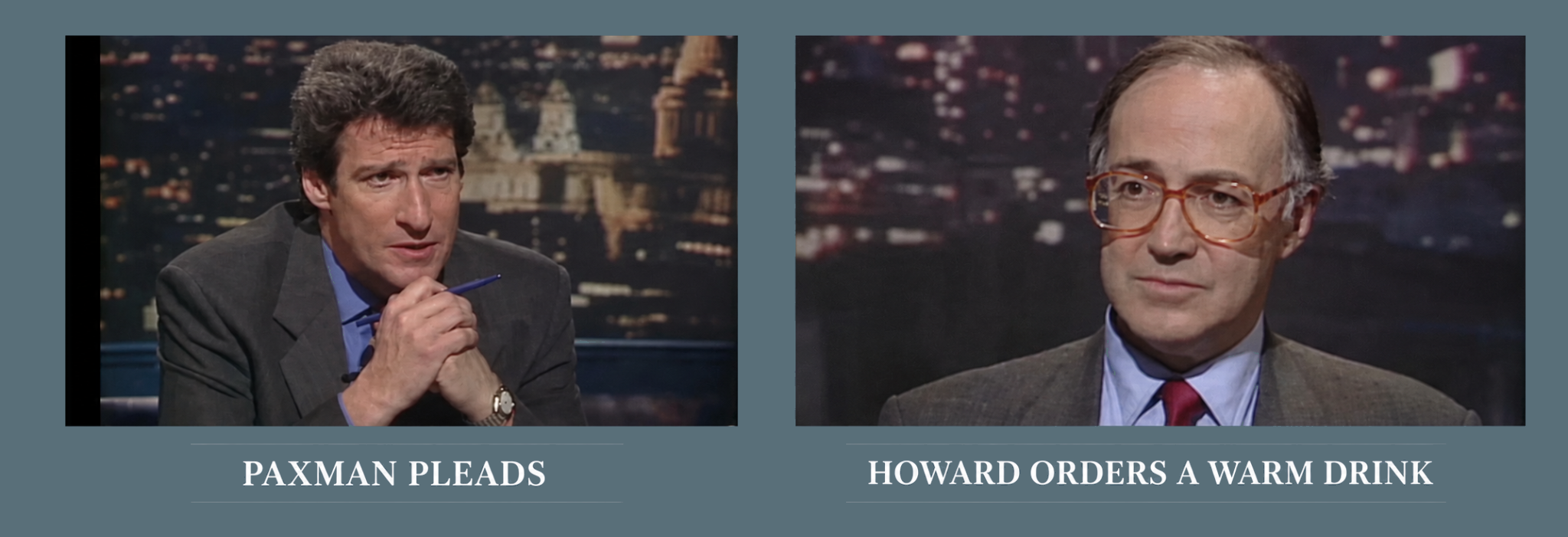
In 1997, BBC interviewer Jeremy Paxman asked British politician Michael Howard whether, while serving as Home Secretary, he had threatened to overrule the head of the Prison Service, Derek Lewis.
Howard answered a different question.
Paxman asked again.
Howard again answered a different question.
Paxman asked again.
This continued for a while.
Paxman: Did you threaten to overrule him?
Howard: I did not overrule him.
Paxman: But did you threaten to?
Howard: I gave him the benefit of my opinion.
Paxman: Did you threaten to overrule him?
Howard: I was not entitled to instruct Lewis and did not do so.
And so it went. Sort of.
Paxman: Did you threaten him?
Howard: I have explained my position clearly.
Paxman: Did you threaten to overrule him?
Howard: I take my tea with two lumps.
Paxman: Sir, please answer my question. Did you threaten to overrule Derek Lewis?
Howard: And milk, please.
Paxman eventually asked the same question 12 times before giving up. Howard never answered it.
If, by whiskey
If absolutely forced to choose between incompatible positions, just split the difference. Choose both.
Being a Mississippi politician in the 1950s was not easy. A culture war pitted the Drys, who wanted to keep the state ban on liquor sales for moral reasons, against the Wets, who viewed the ban as unenforceable. The Wets wanted the tax revenue. Perhaps they also enjoyed booze. These positions were incompatible. Both sides dug in. There was no room for compromise.
At a banquet on the evening of April 4, 1952, young politician Noah S. Sweat Jr., appropriately nicknamed “Soggy,” was asked to reveal his new “universal approach” to the whiskey question. At last, a solution seemed within reach.
My friends, I had not intended to discuss this controversial subject at this particular time. However, I am told that this item is on your minds, and I want you to know that I do not shrink from controversy.
Everybody! Listen up!
If when you say whiskey you mean the devil's brew, the poison scourge, the bloody monster that defiles innocence, dethrones reason, destroys the home, creates misery and poverty, literally takes the bread from the mouths of little children; if you mean the evil drink that topples the Christian man and woman … into the bottomless pit of degradation, and shame … then certainly I am against it.
How could you not be? The Drys clap.
But, if when you say whiskey you mean the oil of conversation, the philosophic wine, the ale that is consumed when good fellows get together, that puts a song in their hearts and laughter on their lips, and the warm glow of contentment in their eyes; if you mean Christmas cheer … if you mean that drink, the sale of which pours into our treasury millions of dollars, which are used to provide tender care for our little crippled children, our blind, our deaf … to build highways and hospitals and schools, then certainly I am for it.
Yes, Soggy! Yes! The Wets clap.
This is my stand. I will not retreat from it. I will not compromise.
Soggy was adamant.
The Drys prayed. The Wets poured a round.
Everyone clapped. Everyone was happy.
Nothing was revealed.
Conclusion
Questions create an unfortunate expectation that they will eventually be answered. Do not be intimidated by this puerile convention. Providing an answer is but one possible response, and usually the least helpful.
You need not lie. You need not feign ignorance. Your response is limited only by your imagination.
You can clarify. You can contextualize. You can reassure. You can express concern. You can correct the questioner’s assumptions. You can explain what will happen next. You can thank them for raising the issue. You can even ask a question of your own.
The particular technique is secondary.
What matters is discipline.
What matters is WILL.
Never, ever, EVER, under any circumstances, answer the fucking question.